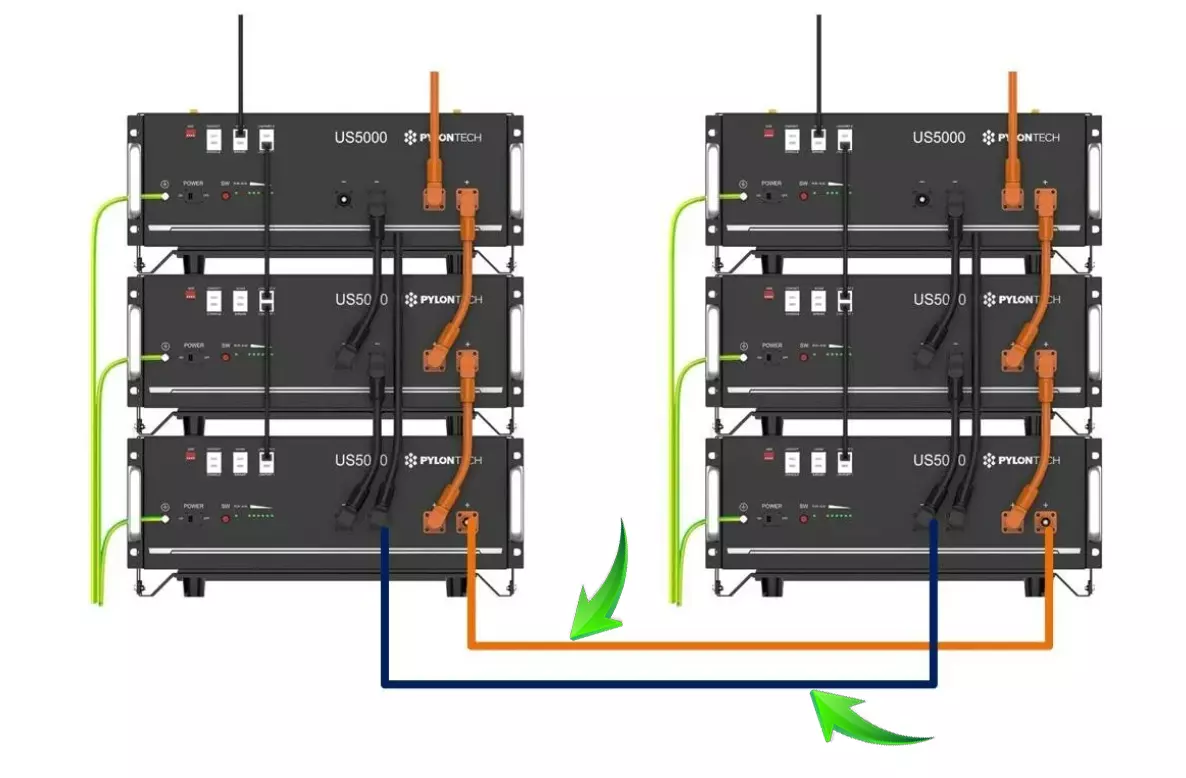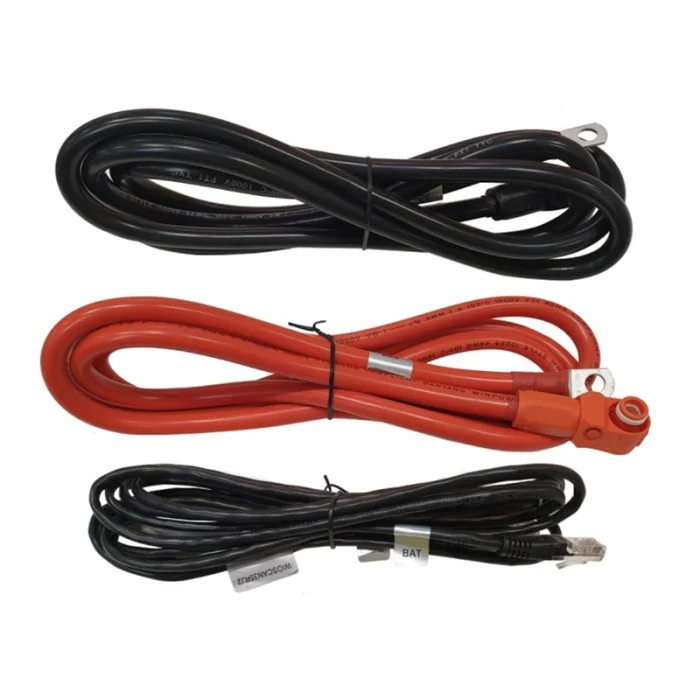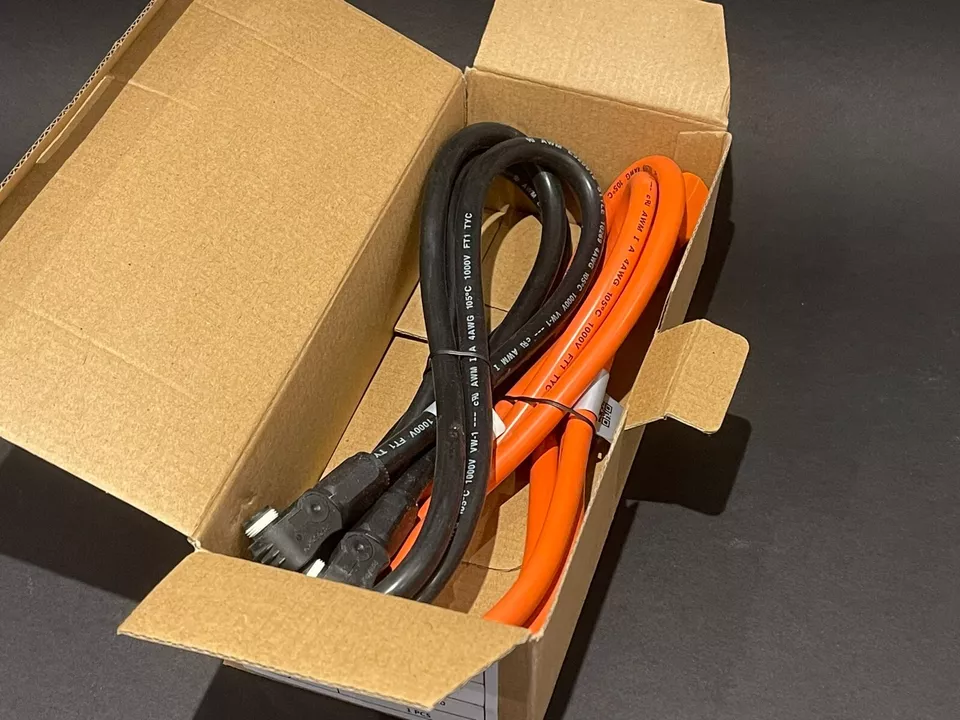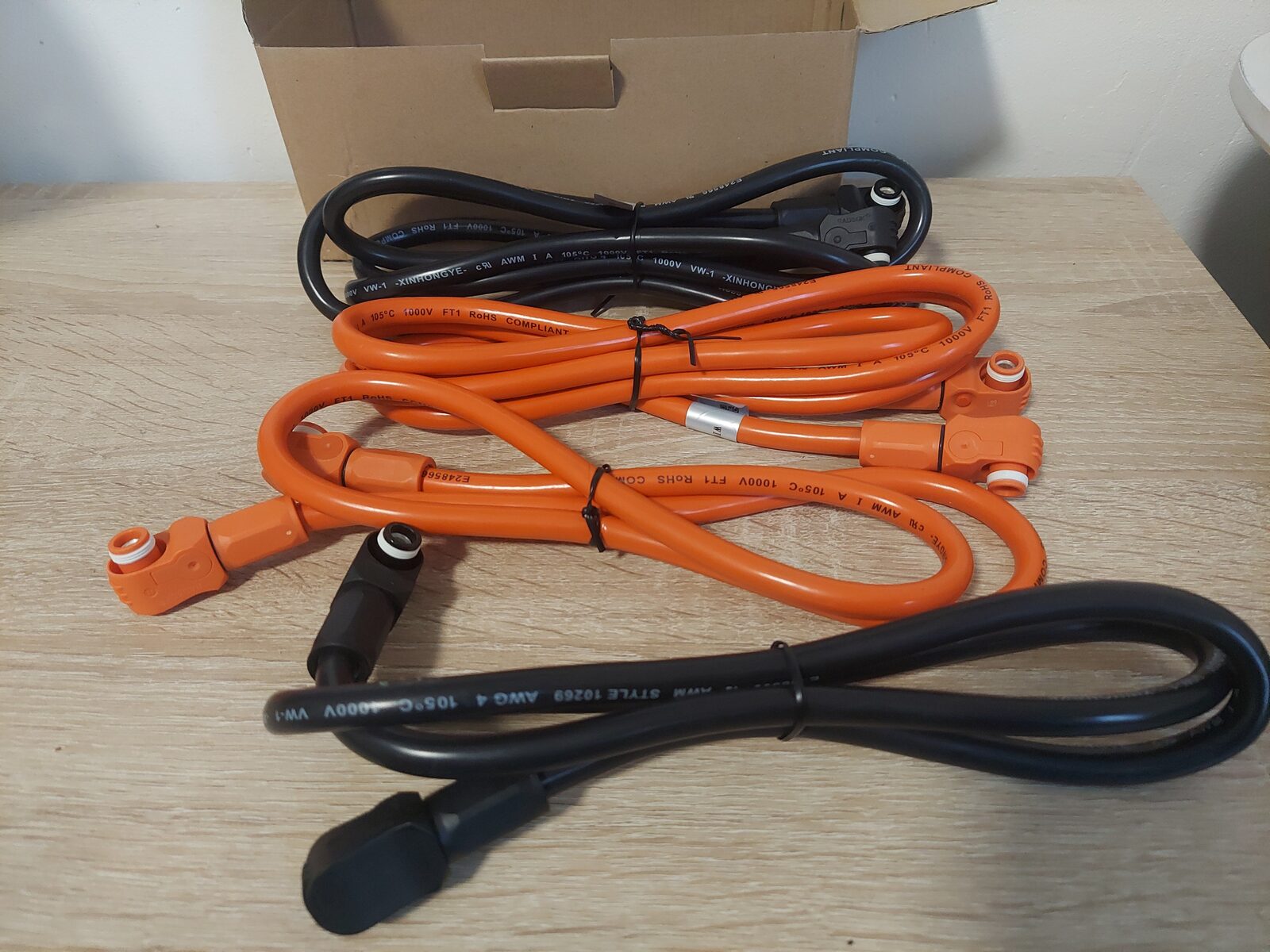
The cables that come in the box with a Pylontech, Dyness or BYD module are designed for one layout: modules stacked tightly on top of each other, in the same rack. The moment you mount batteries side by side, split them across two racks, put them on a wall or leave a gap for ventilation, those short cables no longer reach. This guide shows how to measure the length you actually need, how much slack to leave, which standard lengths fit which layouts, and why every cable in a parallel bank should be the same length.
Measure the real path the cable will follow (not the straight line), from the centre of one battery terminal to the centre of the next, around any rack upright or cable tray. Add 10 to 15 cm of slack for the bend at each connector, then round up to the next standard length. For tightly stacked modules, 48 cm is usually enough; side by side in the same rack, 70 cm or 1 m; between two racks or on a wall, 1 m to 2 m. Use the same length for every link in the bank.
Why cable length matters more than you think
A cable that is too short is obvious: it does not reach, or it reaches only by pulling on the connector. That tension is a real problem. It loads the latch of an Amphenol SURLOK Plus plug or the stud of a ring lug permanently, and over months the contact can work loose.
A cable that is too long is less obvious but has its own costs. Every extra metre of 25 mm² copper adds roughly 0.7 milliohm per conductor. That sounds tiny, and on a single link it is. But in a parallel bank, what matters is the difference between links. If battery 1 sits on 50 cm cables and battery 4 on 2 m cables, battery 1 will systematically take a larger share of the charge and discharge current. Over thousands of cycles, that uneven sharing means uneven ageing.
So the goal is not "as short as possible". The goal is: long enough to avoid strain, and the same length for every link.
How to measure, step by step
- Place the batteries where they will live. Measure on the final layout, with the rack fixed and the modules in position. A few centimetres of shift after installation is enough to make a measured cable too short.
- Locate the terminals. On Pylontech US-series modules, the power terminals are on the front panel. Measure from the centre of the positive terminal of one module to the centre of the positive terminal of the next (and the same for negative).
- Follow the real route. Use a piece of string or a flexible tape and lay it exactly where the cable will go: around rack uprights, through cable management, never across the front of other ports or the battery's switch.
- Respect the bend radius. A 25 mm² cable cannot turn a sharp 90° right at the connector. Allow the cable to leave the plug straight for a few centimetres before it bends.
- Add slack. Add 10 to 15 cm to your measurement. This covers the bends and lets you unplug a module for service without disconnecting the whole bank.
- Round up to a standard length. Then use that same length for all links of the bank, even the ones that could be shorter.
Take a photo of your layout with the string in place and a tape measure next to it. If you contact us for a custom length, that photo lets us check the route and the connector orientation before we assemble anything.
Which length for which layout
| Layout | Typical measured path | Standard length that usually fits |
|---|---|---|
| Modules stacked tightly in the same rack (factory layout) | 20 to 35 cm | 48 cm |
| Stacked with a ventilation gap, or every other slot | 35 to 55 cm | 70 cm |
| Side by side on a shelf or the floor | 50 to 85 cm | 1 m |
| Two racks next to each other | 80 cm to 1.7 m | 2 m |
| Wall-mounted modules, around a corner, or unusual routes | Varies | Custom length |
These ranges are typical, not universal: rack designs differ, and some modules have their terminals on the side or the top. Always measure your own layout.
The "same length" rule, explained
In a parallel bank, all batteries are connected to the same positive and negative points, so they all see the same voltage, but the current each one delivers depends on the resistance of its path. A shorter path means lower resistance, which means more current.
Imagine a bank of four modules connected in a chain, with the inverter cables on the first module. Battery 1 has almost no cable between it and the inverter. Battery 4 has three links in series. Under load, battery 1 works harder than battery 4, and in a long-running system this shows up as small but persistent differences in state of charge and temperature.
Two things reduce that effect:
- Identical link cables between every pair of modules, so no link adds more resistance than another.
- Cross-connecting the main cables: take the positive to the inverter from the first module and the negative from the last module. Every battery then has the same total path length. For banks of five or more modules, a busbar with equal-length cables from each module is even better (we cover it in our busbar vs daisy chain guide).
Do not forget the communication cables
When you move modules apart, the power cables are not the only ones that stop reaching. Pylontech modules talk to each other through RJ45 link cables (Link Port 1 of one module to Link Port 0 of the next), and the master module talks to the inverter through a separate RJ45 cable on the CAN or RS485 port. The short patch cable supplied for stacked modules will not reach a second rack.
Battery-to-battery and battery-to-inverter RJ45 cables are not interchangeable: the inverter cable has its own wiring for the CAN/RS485 pins. See our 3 m battery-to-battery RJ45 cable and 3 m battery-to-inverter RJ45 cable. Unused RJ45 ports are worth closing with silicone port covers in dusty garages.
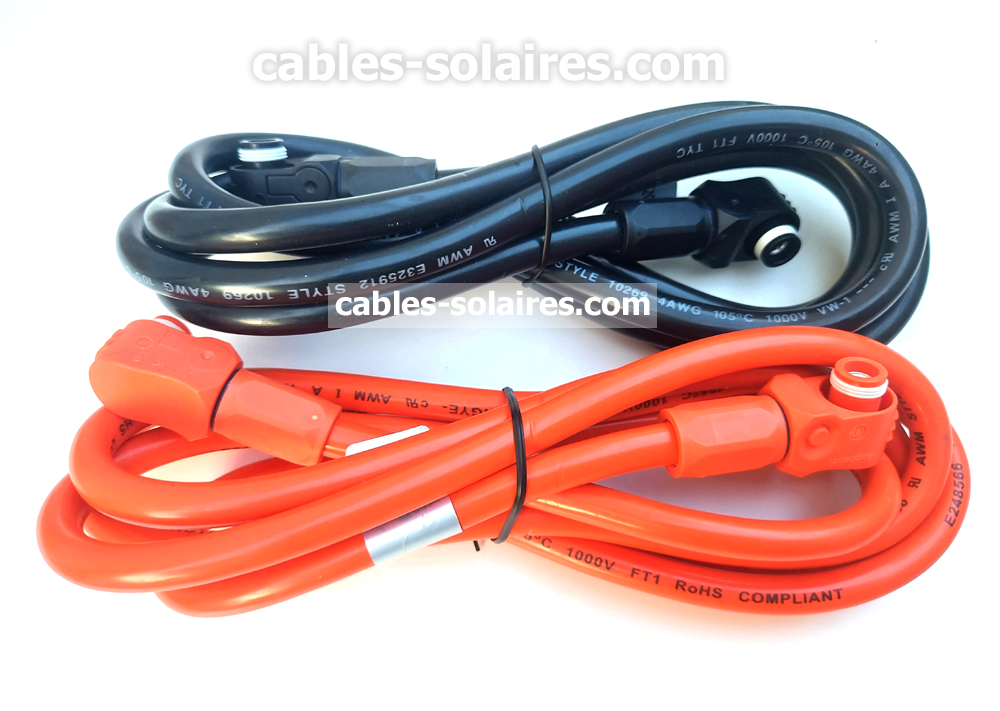
Every standard length, same quality
48 cm, 70 cm, 1 m and 2 m pairs with genuine Amphenol SURLOK Plus connectors and 25 mm² tinned copper, plus single cables in orange or black if you only need one.
Common measuring mistakes
- Measuring the straight line between two terminals instead of the real route around the rack.
- Measuring before the rack is fixed, then discovering the modules sit 5 cm further apart.
- Forgetting connector orientation: a plug that has to exit downwards and then turn up consumes more length than one that exits towards the next module.
- Mixing lengths in one bank because "this one only needed 48 cm".
- Running power cables tightly along RJ45 cables over long distances. Give them some separation where you can.
Frequently asked questions
Are the cables supplied with a Pylontech battery long enough?
They are sized for modules stacked directly on top of each other in one rack. For side-by-side layouts, gaps between modules or a second rack, you will usually need longer cables such as 70 cm, 1 m or 2 m.
Can a cable be too long?
A longer cable adds a little resistance, which is not a problem on its own. The issue is mixing lengths in the same bank: shorter paths take more current. Keep all links the same length and cross-connect the main inverter cables.
Can I join two short cables to make a long one?
No. Every extra junction is another contact resistance and another possible hot spot. Use one continuous cable of the right length.
Do you make lengths between the standard sizes?
Yes. Our custom configurator lets you order the exact length and connector type, assembled with the same hydraulic crimping as the standard range.